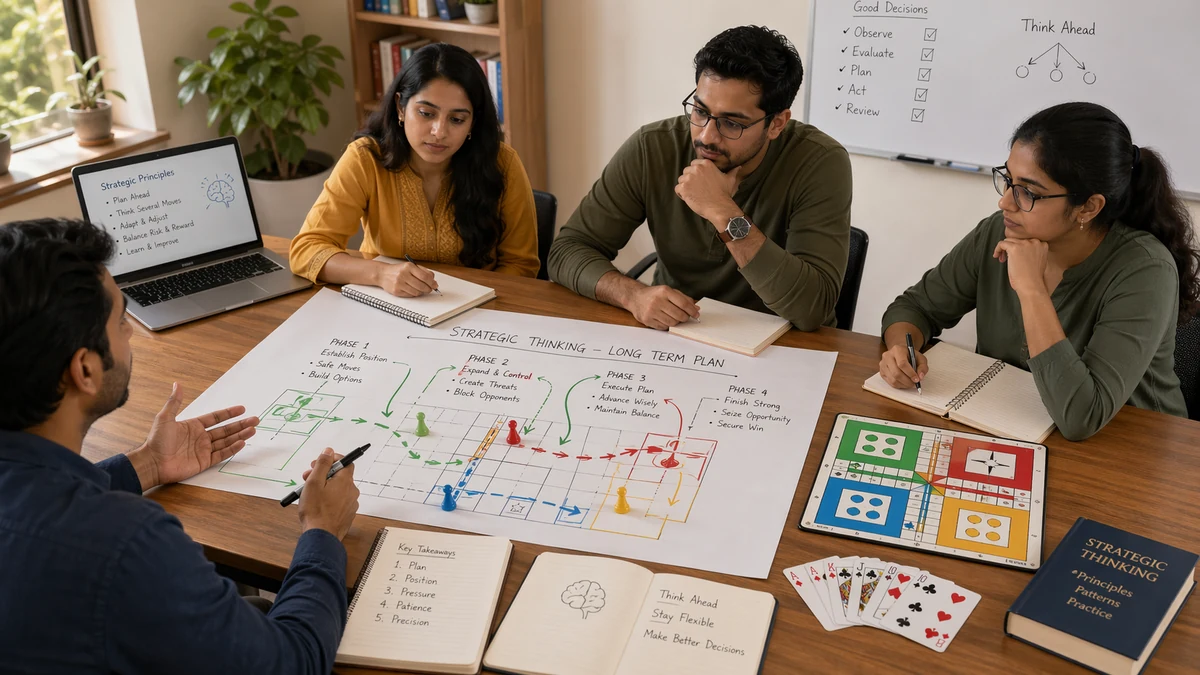
🎯 What strategic thinking really is
Strategic thinking is not endless calculation. It is prioritization across time. You are asking which current choice creates the future you want and which current choice narrows your options later.
🧠 1. Build plans from position, not preference
Many players choose a plan because it matches what they enjoy doing. Stronger players choose a plan because the position supports it. Strategic thinking begins when you let the game choose the plan.
🧠 2. Think in phases
Games shift through phases. Early decisions create later constraints. Midgame choices decide whether pressure grows or stabilizes. Late decisions magnify earlier weaknesses. Thinking in phases helps you understand why the right idea at one moment may be wrong in another.
🧠 3. Protect future flexibility
One of the most underrated strategic habits is preserving options. A line that looks slightly smaller now may be stronger if it keeps several clean continuations open. In both games, future flexibility is often worth more than short-term excitement.
🧠 4. Pressure the right point
Strategy is not about applying maximum pressure everywhere. It is about finding the part of the position that matters most and leaning there. Focused pressure is usually stronger than loud pressure.
🧠 5. Update the plan when conditions change
A good plan is not a prison. If the board or table changes, your strategy must change with it. Many avoidable losses come from loyalty to an old plan after the position stopped supporting it.
Strategic players are consistent in principles, but flexible in execution.
🧠 6. Connect review to planning
To improve strategic thinking, review not just individual moves but the plan itself. Did your plan match the game state? When did it become outdated? Did you notice that in time? This kind of review teaches you how plans live and die inside real games.
⚠️ Common Mistakes
- Choosing plans based on style preference instead of position.
- Treating the whole game as one undifferentiated phase.
- Sacrificing future flexibility for a small immediate gain.
- Applying pressure everywhere instead of at the key point.
- Refusing to adjust once the old plan no longer fits.
🧾 Summary
Ludo and Teen Patti strategic thinking is the skill of linking the current turn to the future shape of the game. Build plans from the position, think in phases, preserve flexibility, and update the plan when conditions change. The stronger your planning habits become, the less often you will feel surprised by positions you helped create yourself.