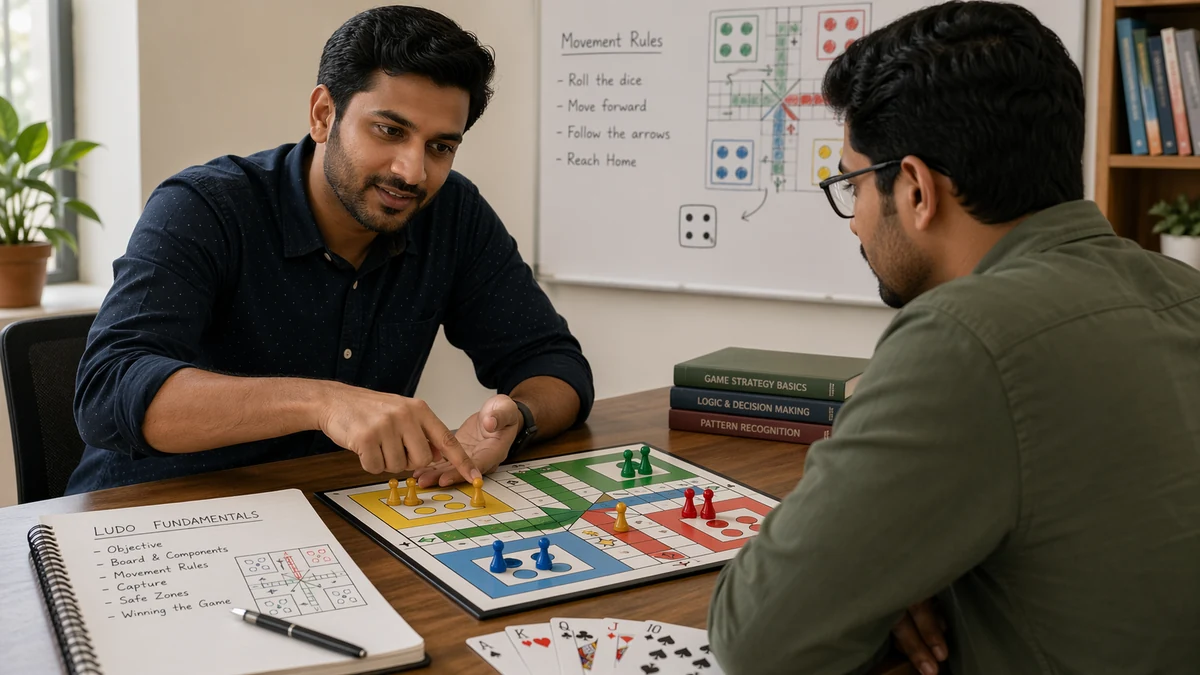
🎯 What Are Fundamentals?
Fundamentals are the repeatable ideas that stay useful in most normal positions. In Ludo, that includes token development, safety, tempo, and route planning. In Teen Patti, it includes hand discipline, awareness of table pressure, position, and the willingness to stop when a situation no longer favors you.
Experienced players lean on fundamentals because they reduce confusion. Instead of improvising from emotion, they return to a few reliable questions: What matters most right now? What am I protecting? What am I giving up? What will this choice look like one turn later?
🧠 1. Know the job of the turn
A common beginner mistake is treating every turn as a chance to do something strong. Better players first identify the job of the moment. Sometimes the job is development. Sometimes it is protection. Sometimes it is pressure. If you misread the job, even a technically legal move can still be strategically weak.
In Ludo, a roll can present several tempting moves, but only one may actually support your overall board shape. In Teen Patti, a hand can look playable, yet the real question is whether continuing fits the table state rather than whether the cards are merely decent.
🧠 2. Protect useful resources
Good fundamentals are resource-aware. In Ludo, your tokens are not equal all the time. An advanced token near a scoring lane may deserve more care than a newly entered one. In Teen Patti, chips, position, and your table image are all resources that can be preserved or wasted.
Newer players often protect the most visible thing instead of the most valuable thing. Stronger players protect what keeps them flexible on the next turn, not what merely feels urgent.
🧠 3. Develop without overextending
Development matters in both games, but reckless development creates weak positions. In Ludo, pushing every token without regard for safety can leave your board scattered and fragile. In Teen Patti, entering too many marginal situations means discipline gets tested far more often than it should.
Expansion is only good when the position can support it. Otherwise you are just reaching a worse position faster.
🧠 4. Respect tempo
Tempo is the value of acting at the right pace. In Ludo, tempo appears in how quickly you bring tokens into meaningful lanes, when you race, and when you pause to stay safe. In Teen Patti, tempo shows up in how pressure builds and whether you are being forced to respond before your read is ready.
Strong players do not think only about the current move. They ask whether a decision improves or worsens the shape of the next one.
🧠 5. Use simple priorities under pressure
Pressure makes people overcomplicate. The cure is not more theory. It is a cleaner order of priorities. First avoid the most damaging mistake. Then preserve useful options. Then take value when it is genuinely there.
Good fundamentals get clearer when the game gets messy. They do not disappear.
🧠 6. Separate patience from passivity
Patient play does not mean refusing every chance to act. It means waiting until the action has support. A patient Ludo player may decline a risky push because the board does not justify it yet. A patient Teen Patti player may stop a continuation that is based more on hope than structure.
Passive play avoids responsibility. Patient play chooses timing. That difference is huge.
🧠 7. Review the basics honestly
After a session, do not jump straight to the dramatic moments. Review the routine ones. Did you protect the right token? Did you enter too many thin situations? Did you rush because you were bored, annoyed, or trying to recover emotionally? Those are the questions that actually improve your fundamentals.
⚠️ Common Mistakes
- Treating every turn as an attacking opportunity.
- Developing tokens or hands without checking whether the position supports it.
- Ignoring tempo and focusing only on the immediate move.
- Confusing patience with fear.
- Reviewing big swings while ignoring routine leaks.
🧾 Summary
Ludo and Teen Patti fundamentals are not exciting because they are supposed to be dependable. If you can read the job of the turn, protect useful resources, respect tempo, and stay patient without becoming passive, your decisions become much easier to trust. That is the base every later strategy page depends on.