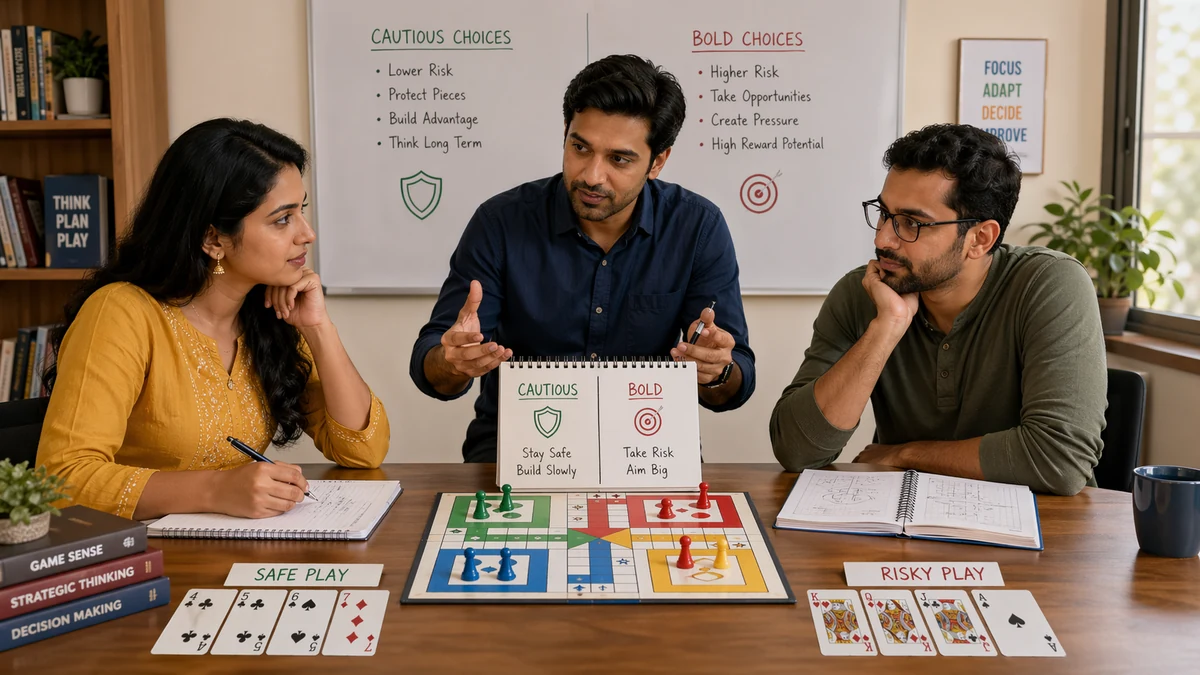
🎯 What balanced risk means
Balanced risk is not about avoiding danger entirely. It is about taking danger that matches the reward, the position, and your ability to recover. A move can be risky and still be correct. It can also be exciting and completely unnecessary.
🧠 1. Know what you are risking
Before taking a sharper line, name the actual cost. Are you exposing a key token, giving up tempo, entering a pressure-heavy Teen Patti spot, or relying on a read that may be thin? If you cannot name the risk, you probably have not measured it.
🧠 2. Measure the reward honestly
Players often exaggerate upside when they want permission to act. A better question is what the move really gains if it works. Does it create a stable advantage, or just a dramatic moment?
🧠 3. Respect recovery paths
Some risky moves are acceptable because the recovery path remains healthy. Others are dangerous because one wrong read leaves you with almost no control. Experienced players value lines that can survive small mistakes. They are not trying to be flawless. They are trying to stay playable.
🧠 4. Match risk to game state
Risk changes value as the game changes. If you are comfortably placed, a lower-variance line may be best. If you are under real pressure, some higher-risk action may become necessary. Urgency should come from the position, not emotion.
🧠 5. Do not let ego choose the risk
One of the worst reasons to take a big line is to prove something to yourself or others. Ego-driven risk feels exciting because it promises emotional relief. Strategically, it is often weak because it ignores the quieter line the position actually supports.
The mature question is not "Can I get away with this?" It is "Does this deserve to be my plan?"
🧠 6. Review risk decisions carefully
Risk decisions deserve special review because results can mislead you. A reckless play that succeeds is still reckless. A justified risk that fails is still worth understanding. Separate whether the line was reasonable from whether the variance was favorable.
⚠️ Common Mistakes
- Taking risk without clearly naming the downside.
- Inflating the reward to justify a move you already wanted.
- Ignoring how hard the position is to recover if wrong.
- Letting ego or frustration set the risk level.
- Becoming so risk-averse that real opportunities are missed.
🧾 Summary
Ludo and Teen Patti risk balance is about choosing danger with purpose, not avoiding it or chasing it blindly. If you can name the cost, judge the real reward, respect recovery, and keep ego out of the equation, your aggressive decisions become much stronger and your cautious decisions become much smarter.