Introduction
Concepts become believable when they are attached to real positions with real pressure, incomplete information, and several imperfect options. That is why scenario work is so valuable. It forces the lesson to stay honest.
Players often improve faster from one well-reviewed scenario than from several pages of generic advice because the memory of a real spot is much easier to revisit.
What Are Skill Game Scenarios?
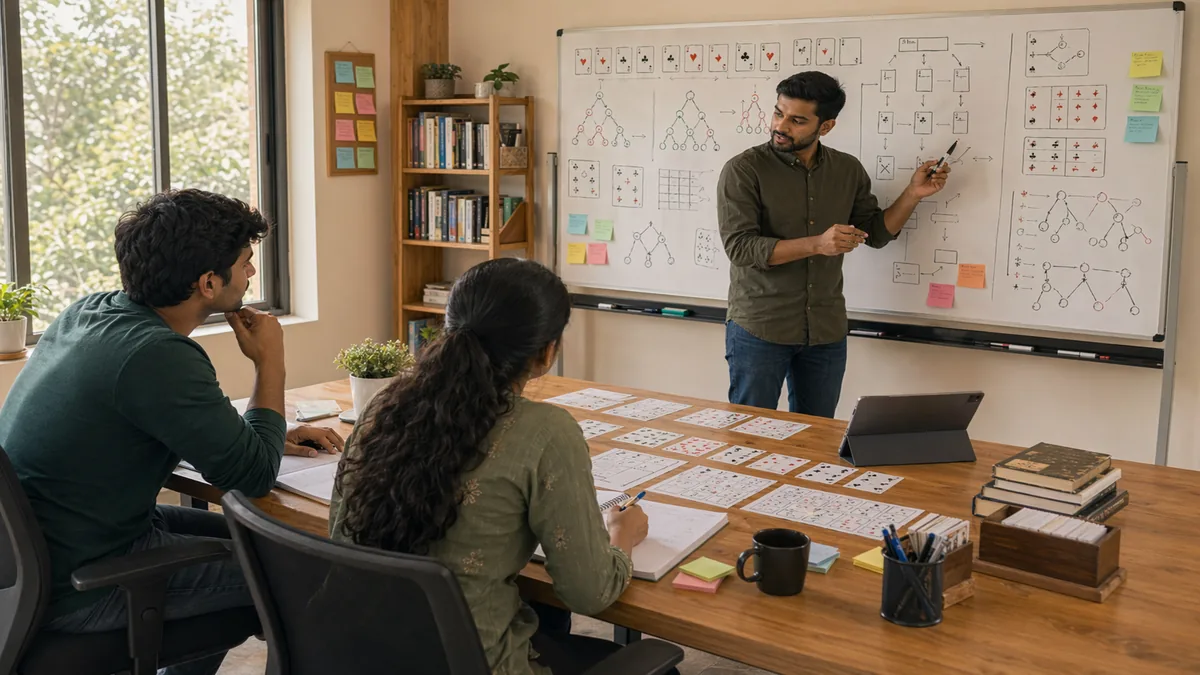
Skill game scenarios are realistic positions or sequences used to study decision making, awareness, timing, and trade-offs. A good scenario is specific enough to feel real but broad enough to teach something reusable.
How To Review Scenarios Properly
1. Pick spots that actually mattered
The best scenarios are turning points, unclear decisions, or spots where a repeated leak appeared again. Reviewing low-value positions often creates the feeling of work without much improvement.
2. Define the key question
Was the spot about survival, pressure, timing, value protection, or transition to the next phase? If that stays blurry, the lesson stays blurry too.
3. Reconstruct the information available at the time
Do not let hindsight rewrite the original decision. Review the scenario based on what you actually knew in the moment.
4. Compare the best two lines
Why did one line feel attractive? What did the calmer line preserve? These comparisons are what turn memory into strategy.
5. Extract one reusable rule
The lesson should end as one practical sentence you can carry into the next session, not as a vague feeling.
Real Session Example
A player first writes, "I should have been more aggressive." After replaying the spot slowly, the better lesson appears: the player never reconstructed the actual information available in the moment. The aggressive line only looked right because the later reveal was already known in hindsight. That is a far more useful correction.
How To Review Scenarios Better
- What was the key question?
- What did I know at the time?
- What were the two best lines?
- What did I misread?
- What one rule do I want to remember next time?
This keeps scenario work focused and practical instead of letting it drift into storytelling.
Common Mistakes
- Reviewing low-value spots instead of turning points.
- Letting hindsight rewrite the earlier decision.
- Describing what happened without naming the real misread.
- Extracting vague lessons that do not transfer.
- Treating scenario study like memorization.
FAQ
What makes a scenario worth reviewing?
Usually a scenario is worth reviewing if it changed the direction of the session or exposed a repeated leak in your process.
Should I review winning scenarios too?
Yes. Some winning spots contain weak reasoning that was hidden by a good result.
Can scenario study replace fundamentals?
No. Scenario work is strongest when fundamentals already give you a language for understanding what went wrong.
Which page pairs best with this one?
Skill Game Decision Making is the clearest companion because scenarios usually revolve around one important choice.
Summary
Skill game scenarios help players learn from real positions instead of vague theory. When you define the key question, rebuild the information honestly, compare real lines, and extract one reusable lesson, scenario study becomes one of the most efficient forms of improvement.