Introduction
Play styles in Indian card games matter because the same hand can become easier or harder to manage depending on who is across the table. A style read changes how pressure is interpreted, how much aggression is respected, and how quickly a reader should update their expectations.
This page explains how to study play styles in a grounded way without turning every player into a fixed label.
Play Styles Overview
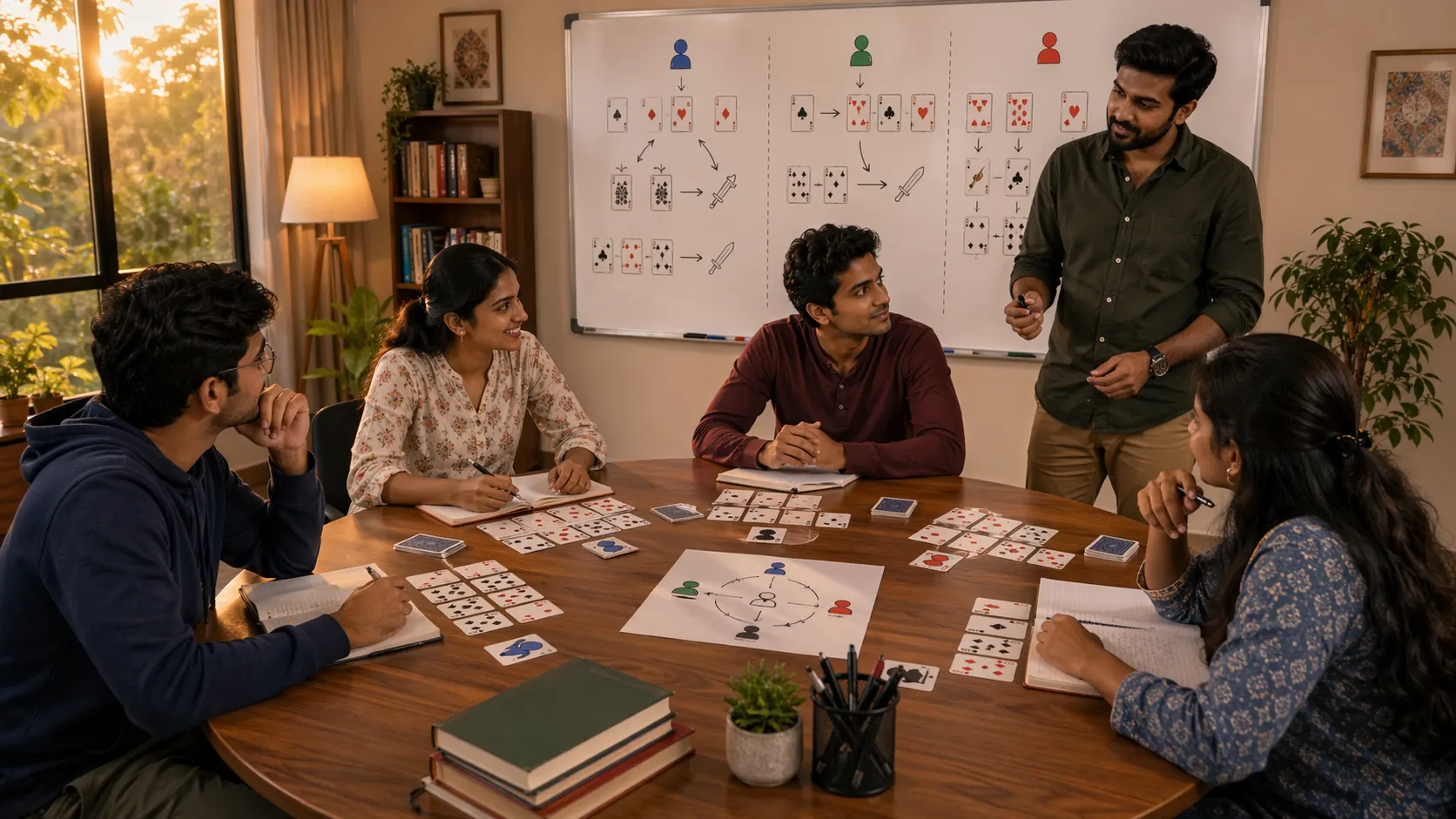
What Are Play Styles?
Play styles are recurring ways players approach risk, timing, pressure, and value. Some players are active and forceful. Some stay patient and defensive. Others change style depending on the round. The useful goal is not to describe people neatly, but to understand how their habits affect the current table.
1. Read Behavior, Not Reputation
A player may have a reputation for aggression or patience, but the stronger read comes from current behavior. Recent repeated choices usually matter more than a label carried into the table beforehand.
2. Notice Style Under Pressure
Play style becomes clearest when the round becomes uncomfortable. Some players tighten too much. Others become too forceful. Those patterns tell readers much more than routine low-pressure turns.
3. Compare Style With Table Context
An active-looking style may come from comfort in one round and insecurity in another. The same visible behavior means more when it is compared with the actual state of the table.
4. Avoid Early Conclusions
One or two hands are rarely enough to support a strong style read. Readers improve faster when they treat early observations as provisional instead of fixed.
5. Study Your Own Style Too
This topic is not only about opponents. Many readers misjudge their own style shifts. They may think they are being balanced when they are actually reacting emotionally to comfort or pressure.
6. Use Style To Improve Timing
Style reads are most useful when they help with timing. They can show when pressure is likely to be real, when it is likely to be exaggerated, and when a quiet response may be stronger than a loud one.
7. Pair Style With Pattern Recognition
Style reading becomes much more useful when it is supported by repeated patterns instead of surface impressions. This helps readers avoid building stories from very small samples.
8. Keep The Read Flexible
Good style reading stays adjustable. The purpose is not to trap the player in a fixed identity, but to improve the quality of the next choice.
Common Mistakes
- Labeling a player too early and never updating the read.
- Confusing visible activity with real strength.
- Forgetting that your own style may also be changing during the session.
Summary
Play styles in Indian card games are useful when they help readers understand pressure, rhythm, and likely reactions more accurately. The strongest style reads come from repeated evidence, not from quick labels.
SEO Keywords
- play styles in Indian card games
- card game strategy
- Indian card game guide
- player styles
- table behavior