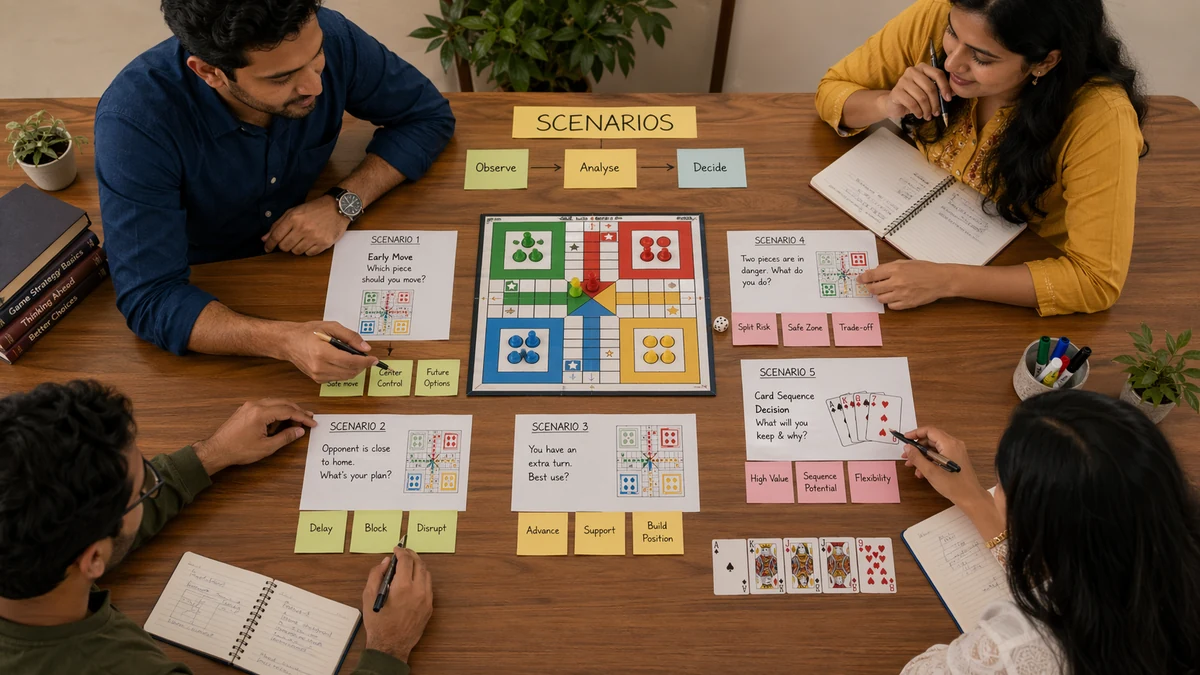
🎯 Why scenario practice matters
Scenario work forces you to think before seeing the result. That matters because many players only agree with strategy after the answer is visible. Real growth happens when you commit to your own reasoning first and then compare it with a stronger framework.
It also teaches one of the most important strategic truths: the right answer changes when one meaningful detail changes.
🧠 1. Ludo race vs safety scenarios
One classic Ludo scenario is choosing between advancing a token aggressively or improving safety across the board. These spots teach that speed is only valuable when the route remains practical.
🧠 2. Ludo development choice scenarios
Another useful group of scenarios asks whether to enter or develop a fresh token versus improving an already active one. These positions teach resource value and board shape. Players who always choose the same answer usually have not learned to weigh context yet.
🧠 3. Teen Patti pressure scenarios
In Teen Patti, a core scenario type is whether current pressure represents real strength, table habit, or emotional momentum. These spots are excellent for learning because the cards alone do not solve the whole problem.
🧠 4. Thin continuation scenarios
Many useful training moments come from borderline spots. You are not clearly ahead, but the spot is not obviously bad either. These are the decisions where discipline grows.
A scenario is useful when it forces you to explain why you continue, not just whether you can.
🧠 5. Recovery scenarios
Another important category is the recovery spot: you made a weaker earlier decision and now need the least damaging path forward. These scenarios are valuable because they teach damage control instead of fantasy rescue plans.
🧠 6. Opponent habit scenarios
Scenarios become richer when opponent style enters the picture. The correct line against a cautious opponent may differ from the correct line against an impulsive one, even if the visible position looks similar.
🧠 7. Review method for scenario work
Use a simple method every time: state the real question, name the two strongest options, explain the trade-off, pick your line before checking the answer, then review whether your reasoning found the key detail.
⚠️ Common Mistakes
- Looking at the answer before making your own decision.
- Memorizing outcomes without understanding the reason behind them.
- Ignoring one small detail that changes the whole spot.
- Treating every scenario as if there must be one universal rule.
- Using scenarios for entertainment instead of deliberate practice.
🧾 Summary
Ludo and Teen Patti scenarios are valuable because they train applied thinking. The strongest way to use them is to decide first, explain your logic clearly, and then compare it with a stronger reading of the same spot. Over time, that habit turns theory into something you can actually use.