🪶 Introduction
Once you have mastered Callbreak fundamentals, common mistakes, and basic strategy, the next step is understanding the deeper concepts that skilled players use to consistently outperform their opponents. Advanced concepts build on foundational knowledge and introduce strategic layers that are not immediately obvious.
This guide covers the more sophisticated aspects of Callbreak play — the concepts that separate good players from great ones. Whether you are looking to improve your own game or understand what experienced players are doing differently, these concepts provide the framework for advanced Callbreak thinking.
🖼️ Callbreak Advanced Concepts Overview
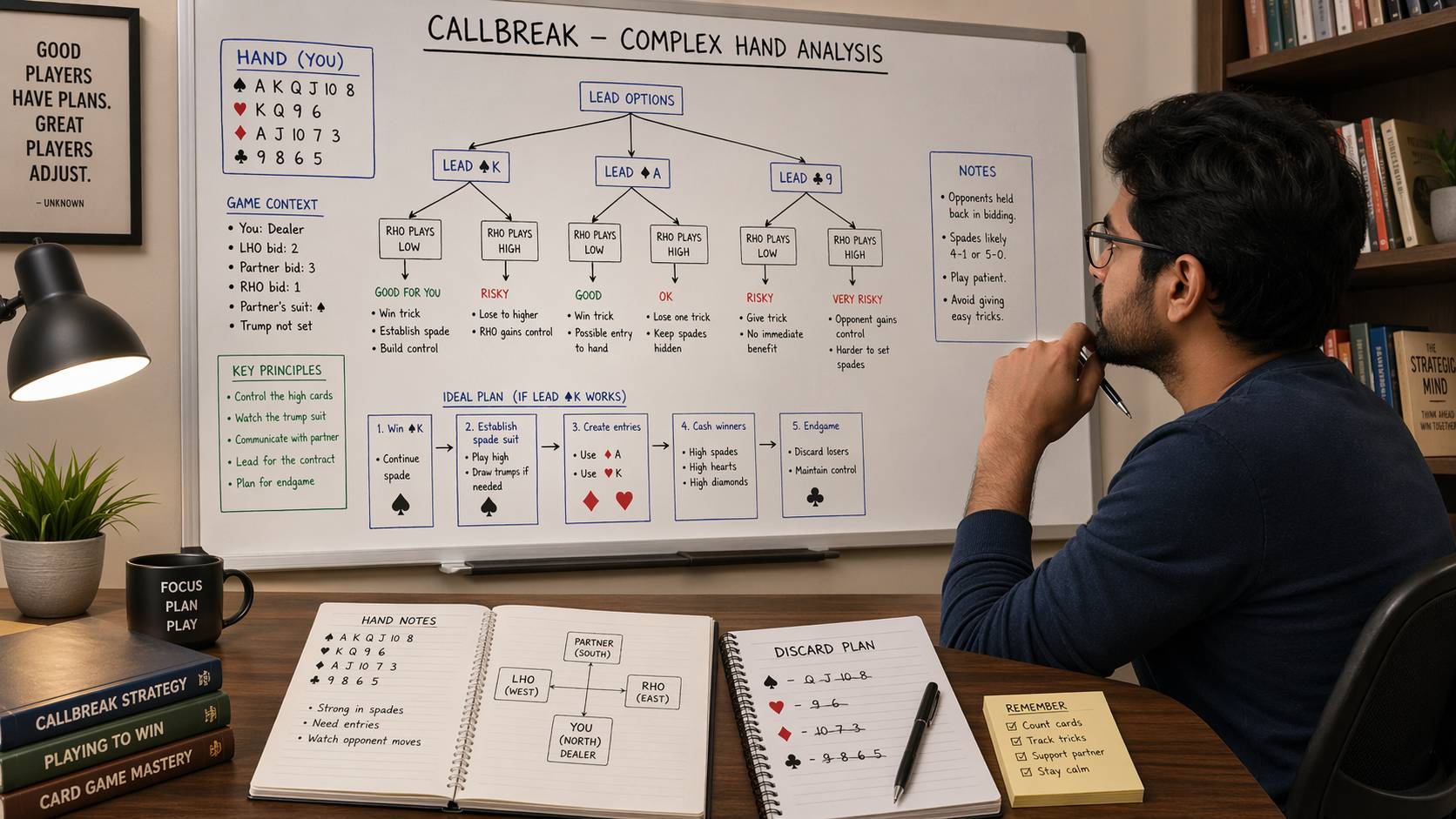
🎯 What Makes a Concept "Advanced"?
Advanced concepts share certain characteristics:
- They build on fundamental skills rather than replacing them
- They require experience to execute well
- They involve multiple variables that must be weighed together
- They often involve trade-offs rather than clear right-or-wrong choices
- They differentiate consistent performers from sporadic ones
Understanding advanced concepts does not guarantee immediate improvement — application and experience are required. But they provide the intellectual framework for continued growth.
🔐 Information Asymmetry and Advantage
Experienced players understand that information is a resource, and managing it strategically creates advantage. Every card you play reveals something about your hand. Skilled players control what they reveal and what they conceal.
What Is Information Asymmetry?
Information asymmetry exists when one player knows something that another player does not. In Callbreak, this occurs naturally — you see your own cards but not others'. However, the asymmetry goes deeper than that. Through your play choices, you can either amplify or reduce the information gap between yourself and opponents.
Creating Information Asymmetry Deliberately
- Through play tempo: The speed at which you make decisions communicates confidence or uncertainty
- Through card selection: Choosing which card to play reveals information about your hand composition
- Through pattern management: Playing consistently in some areas and unpredictably in others creates a complex information environment
Exploiting Information Asymmetry
When you have information advantage, make decisions based on what you know that opponents do not. Do not squander your advantage by playing too obviously.
When opponents have information advantage, play more conservatively to reduce the cost of their knowledge and focus on fundamentals that do not depend on private information.
🎭 Table Image Management
Table image is how opponents perceive your playing style. Managing it strategically is an advanced skill that pays dividends in later rounds and future games.
How Table Image Develops
Your table image develops through your visible behavior over multiple rounds:
- Calling patterns: Whether you tend to call high, low, or somewhere in between
- Aggression level: How frequently you lead, raise, and take initiative
- Response to pressure: How you play when your call is at risk
- Pattern consistency: How predictable your behavior is
Using Table Image Strategically
A tight, reliable image means opponents will trust your calls and leads more readily, allowing you to make plays that opponents respect even when you are bluffing.
A loose, aggressive image creates opportunities for well-timed strong plays where opponents disbelieve your strength.
Managing Your Image Actively
- Occasionally deviate from your established pattern to create confusion
- Use your image to mislead opponents about your actual holdings
- Adjust your visible behavior to create the image that serves your current strategy
- Consider how you want opponents to perceive you before each round
📊 Range-Based Thinking
Rather than trying to read exactly what card an opponent holds, experienced players think in ranges — the set of possible holdings consistent with their behavior. This acknowledges the inherent uncertainty in card games and prevents overconfidence in reads.
What Is Range-Based Thinking?
Instead of thinking "They have the Ace of hearts," think "They have a high probability of holding one of the top cards in hearts, based on their play in this suit."
Why Ranges Matter
Single-read thinking fails because card games involve natural variance that no read can eliminate. Range thinking succeeds because it accounts for multiple possibilities and adjusts decision-making based on probability-weighted outcomes.
Building Ranges
Based on observable behavior, estimate the range of hands an opponent might hold:
- What cards have they played that constrain their possible holdings?
- What suits have they shown consistent strength or weakness in?
- How does their calling behavior suggest their general hand strength?
- What does their tempo and body language suggest about their confidence?
Updating Ranges
Ranges are not static. Update them as new information becomes available. Each new card played narrows or expands the range. Do not cling to outdated ranges just because they were accurate earlier.
⚖️ Exploitative vs. Game Theory Optimal Play
There are two main strategic approaches in Callbreak: exploitative play and game theory optimal play. Understanding when to use each is an advanced skill.
Exploitative Play
Exploitative play means adjusting your strategy to exploit specific weaknesses in your opponents' games. Rather than playing "correctly" in a vacuum, you tailor your approach to what specific opponents are doing wrong.
When exploitation is appropriate:
- When you have identified a consistent opponent weakness through observation
- When opponents are not adjusting to your adjustments
- When the gains from exploitation outweigh the risks of deviating from otherwise sound strategy
Game Theory Optimal (GTO) Play
GTO play means making the decisions that are correct regardless of what opponents do. It is based on equilibrium strategies that cannot be exploited because they do not create exploitable patterns.
When GTO is appropriate:
- Against unknown opponents where exploitation is not yet possible
- When opponents are skilled and likely to notice and adjust to your exploits
- When you do not have enough information to identify specific weaknesses worth targeting
- As a baseline default that keeps you in good shape regardless of opponent strategy
Blending Both Approaches
Most experienced players blend both approaches fluidly. Default to GTO-style fundamentals as a baseline, then switch to exploitative adjustments when specific opportunities arise.
🛡️ The Art of the Block Play
Block plays are specific maneuvers designed to prevent opponents from achieving their goals, even at some cost to your own success. Understanding when to block and when not to is a mark of advanced play.
Understanding Block Plays
Sometimes the correct strategic play is not to win a trick yourself, but to prevent an opponent from winning it. This is a block play. The block sacrifices your own immediate success to deny opponent success.
When Block Plays Make Sense
- An opponent is close to fulfilling their call and blocking prevents their success
- Denying an opponent a specific trick creates strategic advantage for your team
- The cost of the block is lower than the benefit of preventing opponent success
- Your partner is positioned to benefit from the opponent's disruption
Types of Block Plays
- Direct blocks: You play the card that prevents the opponent from winning the specific trick they need
- Suit denial blocks: You lead a suit where the opponent needs to win a trick but lacks the resources
- Trump blocks: Using your trump to win a trick the opponent expected to win
⏱️ Tempo Control and Momentum Management
Tempo refers to the speed and feel of the round's progress. Controlling tempo is an advanced strategic skill that shapes who is reacting and who is initiating.
What Is Tempo in Callbreak?
Tempo in Callbreak relates to more than just card play speed. It encompasses:
- How quickly tricks are being won and lost relative to expectations
- Which team is setting the round's agenda through their leads and plays
- The perceived urgency of decisions — high tempo creates pressure
- Which players are in control of the round's narrative versus being responsive
The Mechanics of Tempo Control
When you control tempo, you dictate the round's pace and direction:
- Leading in situations where opponents must respond to you
- Setting the suit agenda rather than following opponent leads
- Creating situations where opponents must make difficult decisions under time pressure
- Taking the initiative in the narrative so opponents are always responding to your story
Reclaiming Tempo
To reclaim tempo from opponents:
- Look for a single high-value play that shifts the narrative
- Change the suit in a way that disrupts their current strategy
- Apply pressure in an area where they are weak
- Coordinate with your partner to create a two-front challenge
❓ FAQ
What is information asymmetry in Callbreak?
Information asymmetry exists when one player knows something that another player does not. Skilled players control what they reveal and what they conceal through their play choices.
What is range-based thinking?
Range-based thinking means considering the set of possible holdings consistent with an opponent's behavior, rather than trying to read exactly what card they hold. This acknowledges uncertainty and works with probabilities.
What is the difference between exploitative and GTO play?
Exploitative play adjusts your strategy to exploit specific opponent weaknesses. GTO play makes decisions that are correct regardless of what opponents do, based on equilibrium strategies that cannot be exploited.
When should I use block plays?
Use block plays when an opponent is close to fulfilling their call, when denying them a trick creates strategic advantage for your team, and when the cost of the block is lower than the benefit of preventing their success.
How do I manage my table image?
Occasionally deviate from your established pattern, use your image to mislead opponents about your actual holdings, and adjust your visible behavior to create the image that serves your current strategy.
🧾 Summary
Advanced Callbreak concepts provide the framework for continued growth:
- Manage information asymmetry deliberately through play tempo, card selection, and pattern management
- Develop and manage your table image strategically across multiple rounds
- Think in ranges rather than specific reads to account for uncertainty
- Blend exploitative and GTO approaches based on opponent skill and information available
- Use block plays selectively to prevent opponent success when the cost-benefit ratio is favorable
- Control tempo and momentum to shape who is reacting and who is initiating
- Plan across multiple rounds to serve long-term game goals
Understanding advanced concepts does not guarantee immediate improvement — application and experience are required. But they provide the intellectual framework for continued growth.
🔥 SEO Keywords
advanced Callbreak concepts, Callbreak strategy advanced, Callbreak information management, Callbreak table image, Callbreak GTO strategy, Callbreak range thinking, Callbreak block play