🪶 Introduction
Callbreak is not played in isolation. Every round involves reading the players around you, tracking what has happened, and anticipating what is likely to happen next. Game awareness — the ability to observe systematically, interpret what you see, and adjust your play accordingly — is what separates Callbreak players who improve quickly from those who remain at the same level regardless of experience.
🖼️ Callbreak Game Awareness Overview
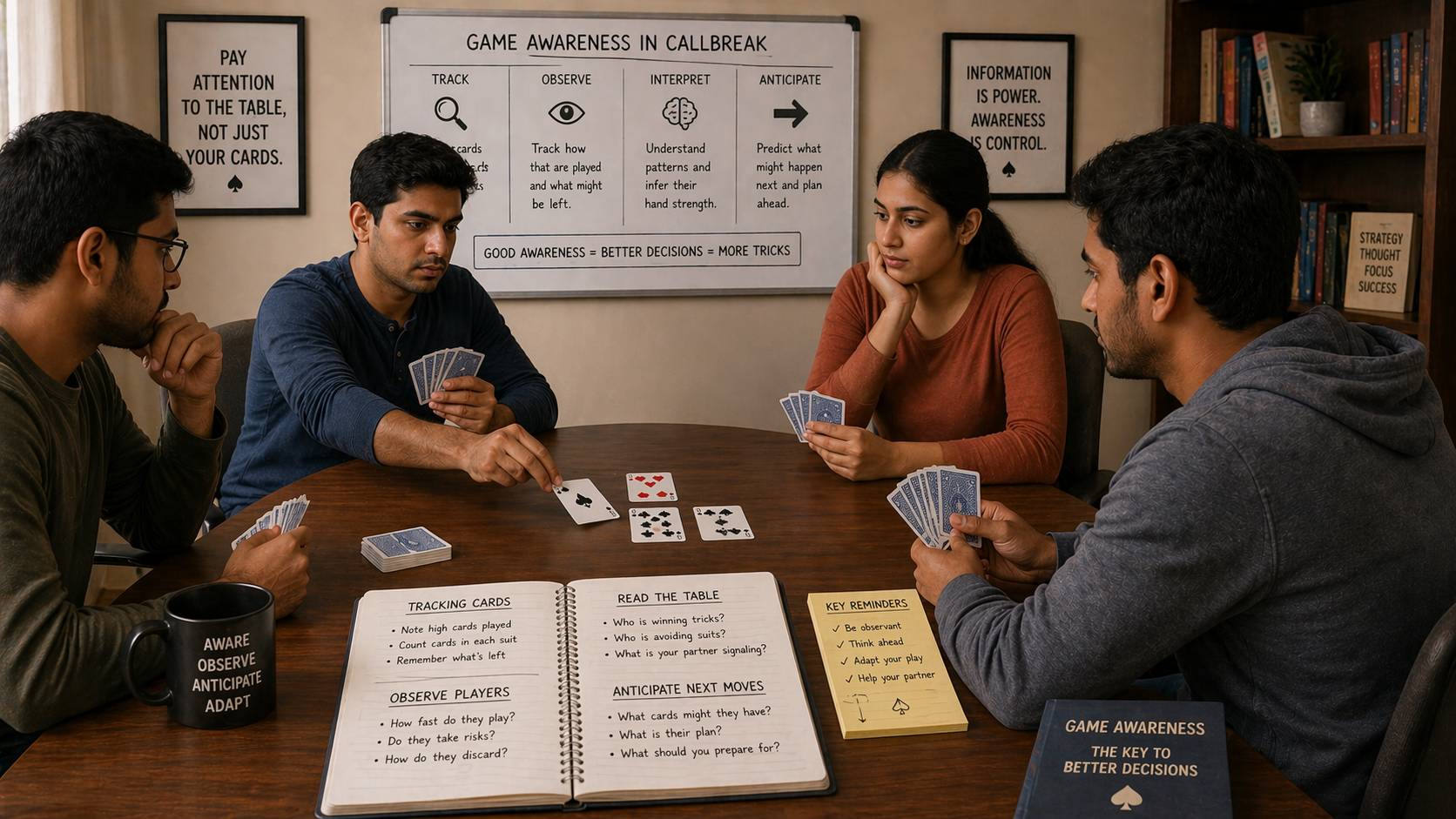
🎯 What Is Game Awareness?
Game awareness in Callbreak means understanding the full context of the round, not just your own hand. It includes:
- Knowing which cards have been played
- Understanding what your partner likely holds based on their actions
- Recognizing patterns in opponent behavior
- Sensing how the table mood and tempo are shifting
- Anticipating likely outcomes before they happen
Game awareness is not about reading minds. It is about making educated inferences from observable information and using those inferences to make better decisions.
🃏 Card Tracking: The Foundation of Awareness
You cannot make informed decisions without knowing which cards are no longer in play. Card tracking is the foundation on which all other awareness skills rest.
Basic Card Tracking
Track the following at minimum:
- How many trump cards have been played
- Whether high cards (A, K, Q, J) in each suit have appeared
- Which suits have been led frequently or infrequently
- The approximate number of cards each opponent has played in each suit
Practical Tracking Methods
Most players cannot memorize every card played. Instead, use a simplified system:
- Keep mental notes on the top 2-3 cards in each suit
- Note when a player wins a trick with an unexpectedly high or low card
- Pay attention to whether players follow suit easily or are forced to trump
Even imperfect tracking is better than no tracking at all. The more you practice, the better your recall will become.
🤝 Reading Your Partner
You cannot speak to your partner during play, but they are constantly communicating through their card choices. Learning to read those signals is essential.
What Partner Play Tells You
- Playing high early in a suit: Suggests they have strength there and may be trying to establish control
- Playing low consistently: May indicate they are conserving strength for later
- Using trump: They may have a surplus, or they may be protecting against an opponent's strong suit
- Winning tricks decisively: Signals confidence in their hand
- Discarding unexpectedly: May reveal they are out of a suit or saving something specific
Reading Context
A single card play can mean different things in different contexts. Always consider:
- Where are we in the round? (Early, middle, or late)
- What does my partner likely need based on their call?
- What have opponents revealed about their holdings?
👀 Recognizing Opponent Patterns
Opponents, like partners, reveal information through their play. Recognizing patterns helps you anticipate their future actions.
Common Opponent Patterns to Watch For
- Suit Preferences: Some opponents consistently lead or win tricks in specific suits, often reflecting their hand composition
- Betting Behavior: Aggressive early play may indicate trying to establish dominance; passive play often suggests weak hands
- Tempo Changes: A player who suddenly changes their play tempo may be reacting to a change in their hand or the round situation
When Patterns Deviate
The most important signal is often a deviation from a pattern. If a passive opponent suddenly plays aggressively, or a player who consistently follows suit suddenly fails to do so, something has changed.
🎭 Understanding Table Dynamics
The "feel" of the table shifts throughout a round. Understanding these dynamics helps you calibrate your own play.
Questions to Ask About the Table
- Is the tempo fast (many tricks decided quickly) or slow (players hesitating)?
- Are opponents playing cooperatively or against each other?
- Is one team controlling the pace, or is the round competitive?
- Are players showing confidence or uncertainty through their play speed?
Adjusting to Dynamics
- In a fast-paced round, make decisions more quickly but stay disciplined
- In a slow, tactical round, take extra time to analyze before playing
- When opponents are dominant, play more defensively and focus on protecting your call
- When you have control, use it to set up favorable situations for your partner
📍 Position Awareness
Your position in the turn order affects your options and your information level.
Acting Early vs. Late
Early position (first or second to play):
- Less information about what others hold
- Must commit to decisions with less evidence
- More freedom in choosing which suit to lead
Late position (third or fourth to play):
- More information from watching others play first
- Better able to respond to what others reveal
- Easier to follow suit with appropriate cards
📈 Momentum and Shift Recognition
Momentum in Callbreak refers to which team is winning the narrative of the round — not just the trick count, but the sense of control and direction.
Recognizing Momentum
Signs a team has momentum:
- Winning tricks with unexpected strength
- Forcing the other team to play defensively
- Appearing confident and decisive in their play
- Controlling which suits are being played
Responding to Momentum Shifts
If momentum shifts against you, play more conservatively to protect your score. If momentum is with you, press the advantage without being reckless.
❓ FAQ
What is game awareness in Callbreak?
Game awareness means understanding the full context of the round, including which cards have been played, opponent behavior patterns, and table dynamics.
How do I track cards effectively?
Keep mental notes on the top 2-3 cards in each suit, track trump usage, and note when players win tricks with unexpectedly high or low cards.
How can I read my partner's signals?
Watch their card choices: playing high early suggests strength, playing low consistently may indicate conservation, and using trump reveals their holdings.
What are the most important signals to watch for?
Trump suit status, high card locations, partner's likely needs, and opponent suit weaknesses are the most important signals to prioritize.
🧾 Summary
Game awareness gives Callbreak players a significant advantage:
- Track cards systematically to know what has been played and what remains
- Read your partner through their card choices and adjust your play to support them
- Recognize patterns in opponent behavior and anticipate their likely actions
- Understand table dynamics and adjust your tempo and strategy accordingly
- Use your position in the turn order to gather and apply information effectively
- Recognize momentum shifts and respond appropriately to changing round conditions
- Manage your own emotions and stay aware of opponents' emotional states
- Filter information intelligently, focusing on what matters most for each decision
Game awareness is a skill that develops over time with practice. The more attention you pay to these elements, the sharper your reads will become and the better your decisions will be.
🔥 SEO Keywords
callbreak game awareness, callbreak table reading, how to read opponents callbreak, callbreak card tracking, callbreak partner signals, callbreak strategy awareness