🪶 Introduction
In Teen Patti, many players focus only on the current moment: what cards they have, what the current bet is, and whether they should continue or fold.
But strong players think differently.
👉 They think ahead.
Strategic thinking means looking beyond the current action and asking:
- What is likely to happen next?
- How will my opponent respond?
- What result am I trying to create?
This is what separates reactive players from thoughtful players.
🖼️ Strategic Thinking Overview
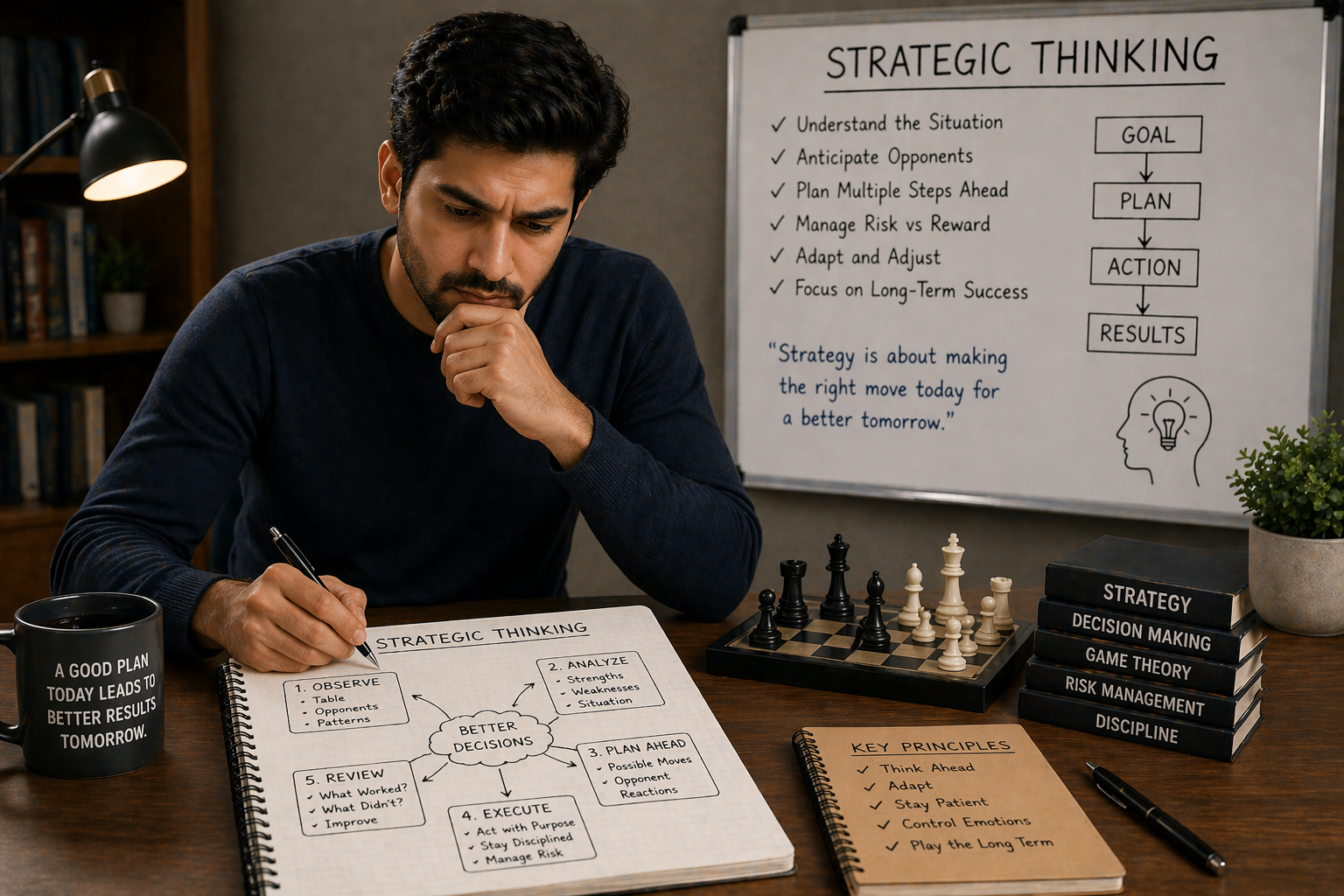
🎯 What Is Strategic Thinking?
Strategic thinking in Teen Patti means making decisions based not only on the present hand, but also on:
- Table dynamics
- Opponent tendencies
- Risk and reward
- Future actions and likely outcomes
A reactive player asks: "What should I do right now?"
A strategic player asks: "What decision now creates the best situation later?"
👉 That difference is huge.
🧠 1. Thinking Beyond the Current Hand
One of the most common mistakes is treating every round as isolated.
In reality, each decision affects:
- Your table image
- Your confidence
- How opponents respond to you later
- The kind of pressure you can apply in future rounds
Example:
If you always play cautiously, opponents may stop respecting your pressure. If you always act aggressively, opponents may start waiting to trap you.
👉 Strategic thinking means understanding that today's action shapes tomorrow's response.
🧠 2. Playing the Situation, Not Just the Cards
Cards matter, but context matters just as much.
The same hand can be:
- Playable in one situation
- Dangerous in another
- Worth pressure in a passive table
- Worth caution against a strong opponent
Questions strategic players ask:
- How many players are active?
- Who is applying pressure?
- Is the table passive or aggressive?
- Do I have enough information?
👉 Strong decision-making comes from combining hand strength + situation awareness.
🧠 3. Planning Multiple Steps Ahead
Strategic players do not think in single moves. They think in sequences.
Instead of: "Should I bet?"
They think:
- "If I act this way now, what will likely happen next?"
- "If my opponent responds aggressively, what is my next move?"
- "If the table stays passive, can I control the round later?"
This creates better choices because:
- You are less surprised
- You avoid panic decisions
- You act with a purpose
👉 A good plan does not guarantee success, but it improves consistency.
🧠 4. Setting a Goal Before Acting
Every action should have a goal.
Before making a move, ask:
- Am I trying to build pressure?
- Am I trying to control risk?
- Am I trying to gain information?
- Am I trying to protect my position?
❌ Acting without a clear reason is a bad habit.
✔ Define the purpose of the action first.
If you do not know why you are acting, your opponents may benefit more than you do.
🧠 5. Understanding Opponent Incentives
Strategic thinking is not just about your plan. It is also about understanding what others are likely trying to do.
Opponents may be trying to:
- Protect a strong position
- Represent confidence
- Recover from earlier mistakes
- Pressure cautious players
- Control the pace of the table
👉 Strategy improves when you stop asking only "What am I doing?" and start asking "What are they trying to achieve?"
🧠 6. Creating Pressure Intentionally
Pressure is most effective when it is purposeful. Unplanned aggression is not strategy.
Strategic pressure means:
- Acting when opponents are likely uncomfortable
- Choosing moments when others are uncertain
- Using confidence to force difficult decisions
Good pressure spots often include:
- Passive tables
- Hesitant opponents
- Situations where your image supports strength
👉 Pressure works best when it is timed well, not just used often.
🧠 7. Protecting Yourself from Predictability
If your decisions always follow the same pattern, good opponents will notice.
Predictable examples:
- Always folding to pressure
- Always acting quickly with weak situations
- Always slowing down before strong moves
- Always increasing pressure in the same kinds of spots
Strategic solution:
- Vary your rhythm
- Mix your responses
- Avoid obvious repetition
- Stay aware of your own habits
👉 Strategic players are not random, but they are hard to read.
🧠 8. Strategic Patience
Not every round needs action. One of the clearest signs of good strategic thinking is patience.
Strategic patience means:
- Waiting for better conditions
- Avoiding forced decisions
- Letting weaker opponents make mistakes
- Not chasing unnecessary opportunities
👉 Sometimes the strongest strategic move is restraint.
🧠 9. Adapting Your Strategy in Real Time
No strategy should stay fixed for too long.
A smart plan at the beginning of the session may become a bad plan later if:
- Table dynamics change
- Opponents adjust
- Confidence shifts
- Pressure increases
- Patterns stop being reliable
Strategic adaptation means:
- ✔ Reassessing constantly
- ✔ Updating your plan
- ✔ Responding to new information
👉 Strong players do not protect old ideas. They protect good decisions.
🧠 10. Managing Short-Term vs Long-Term Thinking
One of the biggest strategic mistakes is focusing too much on immediate results.
A decision can be correct even if the outcome is poor. A decision can be poor even if it works once.
Strategic thinkers ask:
- Was the reasoning sound?
- Did the action match the situation?
- Was the risk justified?
- Would I make the same decision again under similar conditions?
👉 This long-term mindset is what improves performance over time.
🧠 11. Building a Strategic Framework
A useful way to improve is to create a simple framework for yourself.
Before acting, check:
- Situation: What is happening at the table?
- Opponents: Who is strong, passive, aggressive, or uncertain?
- Goal: What am I trying to achieve?
- Risk: What happens if this goes wrong?
- Next Step: What will I do if the response is not what I expect?
This kind of structure prevents emotional and impulsive decisions.
🧠 12. Common Strategic Thinking Mistakes
- ❌ Thinking only one move ahead
- ❌ Using the same strategy against everyone
- ❌ Confusing aggression with intelligence
- ❌ Ignoring how table image affects future rounds
- ❌ Overcommitting to a plan that no longer fits the situation
- ❌ Chasing short-term success instead of long-term consistency
👉 Strategy is not about looking clever. It is about making better choices more often.
🧠 13. How to Improve Strategic Thinking
Strategic thinking improves with reflection.
Useful habits:
- Review your decisions after sessions
- Notice when your plan worked or failed
- Track repeated mistakes
- Compare intention vs outcome
- Ask what information you missed
Good improvement question:
"What was I trying to achieve, and was that the best goal in that moment?"
This makes your thinking sharper over time.
❓ FAQ
What is strategic thinking in Teen Patti?
It is the ability to plan ahead, consider opponent incentives, manage risk, and adapt your strategy based on table dynamics rather than just reacting to the current hand.
How do I improve my long-term Teen Patti strategy?
Review your decisions after sessions, focus on whether the reasoning was sound (not just the outcome), and build a simple decision framework.
Why is patience important in strategy?
Patience allows you to wait for favorable conditions, avoid forced mistakes, and let opponents reveal their tendencies before you commit.
🧾 Summary
Strategic thinking in Teen Patti is about:
- Planning ahead
- Understanding situations
- Reading incentives
- Managing risk
- Adapting in real time
- Thinking beyond one round or one result
🎯 Final takeaway:
👉 Strong players do not just react well — they think clearly before, during, and after every important decision